A red ring seems to be gradually forming across Eastern Europe. In Georgia, elections have been won by a party pushing a pro-Kremlin agenda, a serious blow to the country’s long-standing aspirations to join the European Union. In Moldova, an EU accession referendum narrowly passed amid significant Russian interference in the voting process. Just next to Romania, Budapest is openly supporting pro-Russia stances, as is Slovakia, led by pro-Russian Prime Minister Robert Fico. In Bulgaria, where parliamentary elections were held on Sunday (the seventh round in the last three years), the pro-Russian party „Vazrajdane” (Renaissance) is establishing itself firmly in Sofia’s political landscape.
- articolul continuă mai jos -
In Bucharest, although Diana Șoșoacă (the main propagator of Russian narratives in Romania) was barred from running in the presidential elections—a Constitutional Court decision criticized by numerous pro-democracy analysts—the other far-right party, AUR (led by George Simion), is polling at nearly 20% ahead of parliamentary elections. Additionally, most polls suggest a runoff for the presidency between Ciolacu (from PSD, Romania’s Social Democratic Party) and George Simion. AUR has frequently adopted Kremlin-aligned propaganda themes, such as advocating for „traditional family values” and opposing military support for Ukraine.
Overall, Russia appears to be regaining significant influence across Eastern Europe since the dissolution of the USSR, leveraging a highly powerful and efficient propaganda machine. It is also relying on what some analysts describe as a „bureaucratic and misaligned European apparatus” that does not fully address Eastern realities.
The outcome of the war in Ukraine will be decisive in shaping the future of the region. A defeat for Kyiv could have catastrophic consequences for the entire area, while a Russian defeat could significantly diminish Moscow’s influence, at least in the short term.
How Eastern Europe’s Political Landscape is Shifting
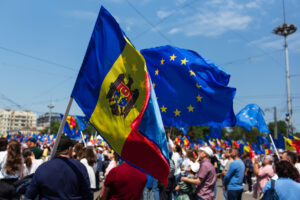
Unprecedented Russian Interference in Moldova’s Election Process
Sursa foto: Photo 282616238 © Andrei F. | Dreamstime.com
The recent referendum in Moldova on joining the European Union barely passed, despite significant Russian interference, particularly through fugitive businessman Ilan Shor (convicted of corruption and now in Moscow). Moreover, while Maia Sandu was initially favored to win the presidential election in the first round, she now faces a runoff against Alexandr Stoianoglo, the pro-Russian PSRM’s candidate.
In the first debate with Maia Sandu, Stoianoglo directly attacked Bucharest, falsely claiming that in the past 30 years, no regional investment projects have brought Moldova closer to the EU.
In Gagauzia, where Moscow’s influence is immense, only 5% of voters supported the EU integration referendum. In this separatist region, Maia Sandu received only 2.26% of the vote in the presidential first round.
Gagauzia’s leadership is controlled by oligarch Ilan Shor. The current regional head, Evghenia Gutsul, was elected with his backing. Both Gutsul and Shor previously mentioned that thousands of pensioners and public sector employees in Gagauzia received funds through cards issued by Russia’s Promsveazybank.
The narrow referendum outcome, which some analysts say should not have been held due to significant public dissatisfaction with the government and a deep-seated nostalgia for the former USSR, has weakened Maia Sandu’s position ahead of parliamentary elections and raised alarms in Brussels, where opinion polls had previously inspired hope for more robust support for EU integration.
Russia exploited the lack of a language barrier and its strong grasp on propaganda machinery to intensively promote classic conspiracy theories on social media, attacking European integration. These narratives ranged from portraying Moldova as a future “Western colony” to claims that LGBTQ agendas and foreign land ownership would undermine the country’s sovereignty.
Georgia’s EU Aspirations Remain Under Moscow’s Grip
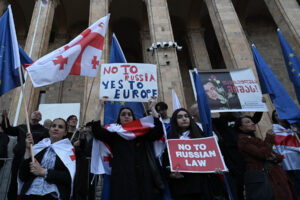
Photo by Vano SHLAMOV / AFP
Parliamentary elections held this weekend in Georgia demonstrate the country’s continued entrapment by Russian influence.
The ruling party, Georgian Dream (GD), won 54% of the vote, while President Salome Zurabishvili and the opposition refused to acknowledge the election results.
GD’s decisive victory deals a blow to Georgia’s long-standing aspirations to join the EU and dampens the opposition’s hopes for a pro-Western coalition.
The European Commission issued an official statement on Sunday night urging Georgian authorities to address electoral irregularities transparently and independently. Similarly, the U.S. State Department released a statement on Monday “encouraging political leaders to uphold the rule of law, repeal legislation that undermines fundamental freedoms, and address electoral shortcomings.”
GD’s campaign accused the pro-Western opposition of trying to drag Georgia into a Ukraine-style conflict. In 2008, Georgia fought a five-day war with Russia, which left deep scars, and Russia’s invasion of Ukraine has amplified fears of potential consequences for aligning with the West.
Support for pro-Western opposition groups generally comes from younger, urban voters who see their political future alongside the EU.
Aligned with the deeply conservative and influential Orthodox Church, the Georgian government has tried to galvanize anti-liberal sentiment by campaigning on “family values” and condemning what it describes as Western excesses.
Last summer, parliament passed restrictive legislation on LGBTQ+ rights, a measure critics say mirrors Russia’s laws against sexual minorities.
In 2022, the EU granted Georgia candidate status, but its membership request was suspended after the controversial “foreign agents” bill, requiring media and NGOs receiving over 20% of foreign funding to register as “foreign influence agents,” was passed in May.
The bill sparked weeks of mass protests in spring, with critics calling it a “Russian law” and comparing it to similar Kremlin legislation introduced a decade earlier to suppress dissent in media and other sectors.
Bulgaria’s Political Instability Continues
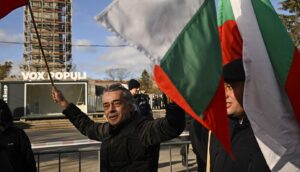
Foto: Nikolay DOYCHINOV / AFP
Bulgaria held its seventh round of parliamentary elections in three years this weekend, a clear sign of the political instability plaguing the EU’s poorest member state.
The center-right party led by former Prime Minister Boyko Borisov placed first in Sunday’s elections, yet uncertainty remains over potential coalition arrangements for forming a stable government.
In Bulgaria’s prolonged political crisis since 1989, the pro-Russian party Vazrajdane (Revival) is solidifying its presence in the political landscape.
Vazrajdane promoted itself in the election by introducing an anti-LGBTQ+ “propaganda” law in schools, inspired by similar Russian legislation.
Boyko Borisov has expressed openness to closer ties with this party, although he has acknowledged, “our partners in Brussels and Washington would not permit” such a scenario.
Since Russia’s invasion of Ukraine, Borisov has aligned himself firmly against Moscow, though experts suggest that a potential victory for Donald Trump in the U.S. presidential elections could alter this stance.
Ahead of the elections, the Bulgarian prosecutor’s office launched hundreds of investigations into alleged electoral manipulation, detaining over 70 individuals suspected of vote-buying, particularly in regions with a strong Movement for Rights and Freedoms (DPS) electorate.
Bulgaria’s political crisis has deterred foreign investors, halted anti-corruption reforms, and delayed the country’s energy transition, jeopardizing the disbursement of billions of euros in European funds. The instability has also postponed Bulgaria’s adoption of the euro and full integration into the Schengen free travel zone. Organizing seven rounds of elections has cost over 300 million euros.
A group of activist hackers known as “Elfi BG” sparked a scandal during the elections by publishing a list of over 200 people suspected of vote-buying to support a new party led by controversial oligarch Delian Peevski.
The vote-buying scheme resembles one in Moldova, where convicted oligarch Ilan Shor, now based in Moscow, is accused of buying around 300,000 votes with illicit funds to derail the EU referendum and ensure the defeat of President Maia Sandu in the presidential elections.
The scandal surfaced amid years-long political and economic tensions, raising concerns about the future of political stability in Bulgaria.
Viktor Orbán, Putin’s Loyal Ally in Europe
sursa foto: Alexander NEMENOV / AFP
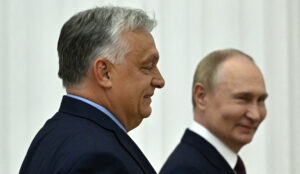
Viktor Orbán remains Russia’s strongest ally within the EU, and this alliance has only strengthened since the large-scale invasion of Ukraine. Orbán did not hesitate to visit Moscow for a meeting with President Vladimir Putin even as Hungary held the EU’s rotating presidency.
Hungary opposes military aid for Ukraine and has consistently tried to block EU initiatives to support Kyiv, both financially and militarily. Orbán also perpetuates Kremlin-backed themes, including support for “traditional family” values and anti-LGBTQ policies.
Notably, the recent rise of the opposition party Tisza, led by Peter Magyar, which has overtaken Orbán’s Fidesz in recent polls among undecided voters, should not be viewed with excessive optimism.
According to Politico, Peter Magyar, though a political newcomer at 43, shares at least one common skepticism with his eurosceptic rival Orbán: neither fully trusts Brussels.
Magyar, a conservative once within Orbán’s inner circle and now a European Parliament member in the center-right European People’s Party (EPP)—from which Orbán distanced himself before being expelled—has said, “We are pro-EU, but not blind to the EU’s deficiencies.”
Magyar’s major divergence with the EPP is his opposition to sending weapons to Ukraine, as he stated in June, noting, “Russia is the aggressor, and Ukraine has the right to defend itself, but we differ on the exact nature of our support.”
Slovak Prime Minister Fico Blocks NATO Membership for Ukraine
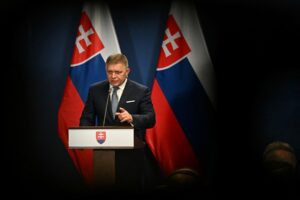
Sursa foto: ATTILA KISBENEDEK / AFP
Under the leadership of pro-Russian Prime Minister Robert Fico, Slovakia has taken a strong stance against delivering arms to Ukraine. Alongside efforts to undermine the rule of law and anti-corruption initiatives domestically, Fico declared in early October that, as long as he leads the government, Ukraine will not join NATO.
“As long as I am the head of the Slovak government, I will instruct the parliament members under my control, as party leader of Smer [the ruling party], to never agree to Ukraine’s NATO membership,” he stated during the weekly program O päť minút dvanásť (translated as „Five Minutes to Twelve”).
Since his re-election in the fall of last year, Fico has abandoned the previous government’s policy of providing material support to Ukraine in its fight against the invading Russian forces. Instead, he has pledged that his government will not send “a single bullet,” aligning with Moscow alongside Hungary’s authoritarian Prime Minister Viktor Orbán, Slovakia’s neighboring leader.
Recently, Fico also promised to “do everything possible to renew standard economic relations with Russia.”
Following his Sunday broadcast, Fico reiterated this commitment by proposing a visit to Moscow in May next year to commemorate the 80th anniversary of the end of World War II, “as long as I am invited.”
During a ceremony held to mark the arrival of Soviet troops at the Dukla Pass, near Slovakia’s border with Poland, on October 6, 1944, Fico emphasized that Russia’s sacrifices contributed to Slovakia’s liberation from Nazi occupation.
“Freedom came from the East,” he stated, “and absolutely nothing can change this truth.”
Also in early October, Slovakia’s Minister of Health, Zuzana Dolinková, announced her resignation due to the government’s support for a prominent anti-vaccination figure and the lack of adequate prioritization for healthcare. Conspiracy theories have become one of the main themes promoted by Russian propaganda on social media.
Serbia Balances Between EU Aspirations and Moscow Ties
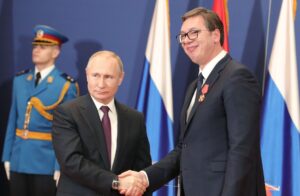
Foto: X.com / President of Russia
For years, Serbia has been juggling its aspirations to join the European Union with its strong ties to Moscow. On October 20, Serbian President Aleksandar Vučić spoke by phone with Vladimir Putin, marking their first conversation in two and a half years.
The call came as the Belgrade leader considered attending last week’s BRICS summit in Kazan. Vučić ultimately decided not to attend but sent the country’s Deputy Prime Minister, who expressed Serbia’s interest in becoming a member of the BRICS group.
Vučić emphasized that while Serbia remains an EU membership candidate, it will not change its position of refusing to impose sanctions on Russia following the invasion of Ukraine. Nevertheless, since the Russian invasion, Serbia has condemned the violation of Ukraine’s territorial integrity, although Vučić’s direct communications with Putin have been limited.
When Russia invaded Ukraine in February 2022, Serbia was entirely dependent on Russian gas. Since then, following the example of many EU member states, Serbia has been seeking alternative energy suppliers.
“If I say I’m going to Kazan, that would mark the end of Serbia’s European path. If I say otherwise, they will claim I betrayed the Russians,” Vučić commented, explaining his decision on BRICS participation.
At the BRICS summit, Serbian Deputy Prime Minister Aleksandar Vulin stated, “Serbia hopes it will find a place in the BRICS group, as it is an organization that offers freedom without requiring systemic changes or adherence to sanctions.”
“In BRICS, we feel among friends. For the first time, we have the freedom to choose, which is very important for Serbia,” added Vulin, who previously served as Serbia’s intelligence chief, is viewed as pro-Russian, and has been sanctioned by the U.S.
Vulin further explained that while the West pressures Serbia due to its “friendly and fraternal” relations with Russia, it also makes additional demands.
He added, “Personally, I do not see Serbia’s future in the European Union,” although he acknowledged that the country “has invested heavily in the European path” and that “it would be irresponsible to halt all EU-oriented activity now.”
During her visit to Belgrade, European Commission President Ursula von der Leyen declined to meet with Serbian Prime Minister Miloš Vučević, who had recently met with Russia’s Minister of Economic Development, Maksim Reshetnikov.
Von der Leyen also noted that “there is information suggesting Serbia’s intention to strengthen its economic relations with the Russian Federation in other areas.”
Republika Srpska: Russia’s Destabilizing Trojan Horse in the Western Balkans
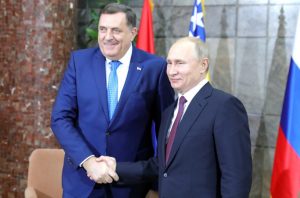
Sursa foto: Kremlin.ru
/https%3A%2F%2Fwww.g4media.ro%2F%2Fwp-content%2Fuploads%2F2024%2F10%2Feuropa-est-influenta-rusia-2.png)

/https%3A%2F%2Fwww.g4media.ro%2Fwp-content%2Fuploads%2Fsfm%2F2026%2F07%2F1765264660%2Fdbb9ebefc57fbb765a7da578c62cfb74-t.jpg)
/https%3A%2F%2Fwww.g4media.ro%2Fwp-content%2Fuploads%2Fsfm%2F2026%2F07%2F1765273333%2F414043e1d5f42c3f408b9c92442614e6-t.jpg)
/https%3A%2F%2Fwww.g4media.ro%2Fwp-content%2Fuploads%2Fsfm%2F2026%2F07%2F1765273352%2F8a8a4dc4c1fe01ea291a8880f06ae78b-t.jpg)
/https%3A%2F%2Fwww.g4media.ro%2F%2Fwp-content%2Fuploads%2F2026%2F07%2Fmilitari-Busteni-1-e1784559282860.jpg)
/https%3A%2F%2Fwww.g4media.ro%2F%2Fwp-content%2Fuploads%2F2026%2F07%2Fhttpsg4food.roce-se-intampla-daca-nu-mai-consumi-paine-timp-de-o-luna.jpg)
/https%3A%2F%2Fwww.g4media.ro%2F%2Fwp-content%2Fuploads%2F2026%2F07%2FPucisti-din-PNL.jpg)
/https%3A%2F%2Fwww.g4media.ro%2F%2Fwp-content%2Fuploads%2F2026%2F07%2Fcolaj.jpg.jpeg)
/https%3A%2F%2Fwww.g4media.ro%2F%2Fwp-content%2Fuploads%2F2026%2F07%2FSorin-Grindeanu-PSD-scaled-e1783941449806.jpg)
/https%3A%2F%2Fwww.g4media.ro%2F%2Fwp-content%2Fuploads%2F2022%2F11%2FPArlament-Cehia.jpg)
/https%3A%2F%2Fwww.g4media.ro%2F%2Fwp-content%2Fuploads%2F2026%2F06%2Fprofimedia-1107154432-scaled.jpg)
/https%3A%2F%2Fwww.g4media.ro%2F%2Fwp-content%2Fuploads%2F2026%2F07%2Fpexels-helen1-30591531-scaled.jpg)
/https%3A%2F%2Fwww.g4media.ro%2F%2Fwp-content%2Fuploads%2F2022%2F05%2FWhatsApp-Image-2022-05-24-at-09.35.18-e1653377048871.jpeg)
/https%3A%2F%2Fwww.g4media.ro%2F%2Fwp-content%2Fuploads%2F2026%2F07%2Fchef-alexandru-burca-viitorul-in-fine-dining-restaurante-meniuri-scurte-produse-locale.jpg)
/https%3A%2F%2Fwww.g4media.ro%2F%2Fwp-content%2Fuploads%2F2026%2F07%2FUntitled-1.png)
/https%3A%2F%2Fwww.g4media.ro%2F%2Fwp-content%2Fuploads%2F2026%2F07%2FPoza-1-gen-Z.png)
/https%3A%2F%2Fwww.g4media.ro%2F%2Fwp-content%2Fuploads%2F2026%2F07%2FTECH-TRENDS-ALEX-BUZICA-2.png)
/https%3A%2F%2Fwww.g4media.ro%2F%2Fwp-content%2Fuploads%2F2026%2F07%2FDAVID-PO.png)
/https%3A%2F%2Fwww.g4media.ro%2F%2Fwp-content%2Fuploads%2F2026%2F07%2FTECH-TRENDS-ALEX-BUZICA-1.png)