 Adaugă-ne ca sursă preferată în Google
 Urmărește-ne in Discover
Prosport
Election day in the U.S. Who will lead America and the free world: Harris or Trump?
/https%3A%2F%2Fwww.g4media.ro%2F%2Fwp-content%2Fuploads%2F2024%2F11%2Fkamala-harris-vicepresedinte-vicepresedinta-sua-statele-unite-alegeri-prezidentiale-sua-2024-democrata-americane-donald-trump-republican-casa-alba-cursa-prezidentiala-washington-dc-3.png)
Sursa foto: Jon Cherry / Getty images / Profimedia + Julia Demaree Nikhinson / AP / Profimedia
Ascultă articolul
Tens of millions of Americans are expected to turn out on Tuesday for Election Day to select the next President of the United States and leader of the free world. The two main candidates, Democrat Kamala Harris and Republican Donald Trump, are neck-and-neck in their race for the White House. Around 80 million voters have already cast early ballots in what experts are calling one of the closest electoral battles in modern U.S. history. The 47th president of the United States will be inaugurated on January 20, 2025.
- articolul continuă mai jos -
Quick Facts
- The U.S. presidential and general election is held on Tuesday, November 5.
- Over 160 million voters are expected to participate.
- Polls show a close race between Kamala Harris and Donald Trump for the White House.
- A candidate must secure 270 electoral votes to become President.
- Alongside the presidency, Americans will elect a significant portion of the legislative seats in Washington.
- This campaign season is the most expensive in U.S. history.
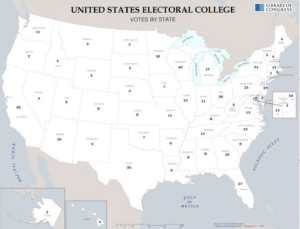
Sursa foto: Library of Congress
Election Statistics
- The general and presidential elections in the United States are set for Tuesday, November 5, 2024.
- Approximately 244 million Americans are eligible to vote in the 2024 elections, encompassing all citizens aged 18 and over, although not all are registered or will vote.
- U.S. demographics among eligible voters have shifted significantly, with the electorate becoming more racially diverse, educated, and older. In 2020, about 67% of eligible voters, or roughly 158.4 million Americans, turned out to vote, a record participation rate that could be matched or exceeded in 2024.
- Voters across all 50 states and the District of Columbia will choose members of the Electoral College, who will then select a President and Vice President for a four-year term.
- The main candidates for the White House are Democrat Kamala Harris and Republican Donald Trump. Harris’s running mate is Minnesota Governor Tim Walz, while Senator JD Vance of Ohio rounds out Trump’s ticket.
Sursa foto: Jim WATSON / AFP / Profimedia + Kevin Dietsch / Getty images / Profimedia
Sursa foto: Jim WATSON / AFP / Profimedia + Kevin Dietsch / Getty images / Profimedia
Key Points in the Presidential Race
The race between the two primary candidates is extremely close, with polls indicating a minimal difference between Harris and Trump.
In addition to Harris and Trump, other presidential contenders include progressive activist Cornel West (independent), Dr. Jill Stein (Green Party), and activist Chase Oliver (Libertarian Party). Several other third-party candidates are on some state ballots but lack the widespread support needed to reach the necessary 270 electoral votes.
On the global stage, the President of the United States has significant freedom to represent the country abroad. Domestically, the President has the authority to enact some policies independently but generally must work with Congress to pass legislation. This year, analysts believe that the presidential race may ultimately be decided in seven swing states: Arizona, North Carolina, Georgia, Michigan, Nevada, Pennsylvania, and Wisconsin.
The winner of the presidential election will serve a four-year term beginning in January 2025. However, the final outcome of the presidential race could be decided by electoral votes in Pennsylvania, with its 19 electoral votes potentially determining the final result.
The name of the winner may not be announced on Tuesday night, as counting votes in the swing states could take days or even weeks. Hispanic or Latino voters could play a decisive role, representing about one-fifth of the U.S. population, or 65.2 million people, and accounting for 14.7% of all eligible voters.
Down-Ballot Elections
In addition to the presidency, Americans will also vote for a significant portion of Congress, some governors, and local officials. All 435 seats in the U.S. House of Representatives and 34 out of 100 seats in the Senate are up for election. Republicans currently hold a 220-seat majority in the House, while Democrats hold 211 seats, with four seats vacant. In the Senate, Republicans hold 49 seats, while Democrats have 46 seats plus four independents who often vote with them.
More than 78.18 million Americans had voted early as of Monday, with over 42.75 million casting ballots in person and 35.42 million returning mail-in ballots. A significant percentage of early voters, 54%, are women, with men making up 43.6%.
Hot-Button Issues
This year’s campaign has focused heavily on issues such as the economy, inflation, illegal immigration, abortion, and LGBTQ rights. The economy remains the top issue for voters.
The 2024 election cycle is projected to be the most expensive in U.S. history, with spending estimated at around $15.9 billion. Contributing factors include inflation and the growing influence of super PACs and external groups, expected to contribute over $5 billion to this election cycle.
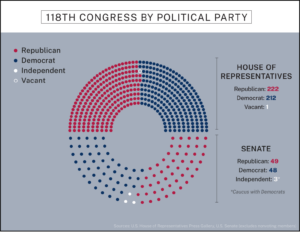
Foto: Congresul SUA / Sursa: Departamentul de Stat
A Different Campaign Season
The race for the White House is undeniably the main event, with Harris and Trump running nearly even, according to recent polling. Initially, President Joe Biden won the Democratic primaries but announced on July 21 that he would not seek a second term. This decision came after months of gaffes and concerns over his health and cognitive abilities. After Biden’s withdrawal, the Democratic Party quickly selected Vice President Kamala Harris as their nominee, officially nominating her at the Democratic National Convention in August.
Critics argue that Harris was imposed by the party’s leadership without an internal election, as she did not participate in any primary races. In the Republican camp, Donald Trump decisively won the nomination, gathering far more delegates than his competitors, including former South Carolina Governor Nikki Haley and Florida Governor Ron DeSantis.
Trump has faced two assassination attempts during his campaign. In July, a gunman wounded him at a rally in Pennsylvania, while in August, Trump’s security team intercepted a suspect at his Florida golf course.
Historical Election
The November 5 election is historic. If Harris wins, she will be the first female, Black, and Asian American President. If Trump wins, he will be the first president to be re-elected after losing his first re-election bid and would also be the first president convicted of a crime.
Poll Results
As of Monday, national polls indicate a tie between Harris and Trump. In key swing states, Trump and Harris remain nearly tied in many areas, with Pennsylvania, Michigan, and Wisconsin as critical battlegrounds for Harris and Georgia, North Carolina, and Arizona remaining close for Trump.
- National Polls: Both candidates are polling around 47%.
- Swing State Polls: In critical states, results vary slightly across polling agencies:
- Nevada: Trump 48.4%, Harris 48.0%
- Arizona: Trump 49.3%, Harris 46.7%
- Wisconsin: Harris 48.6%, Trump 47.8%
- Pennsylvania: Trump 48.4%, Harris 48.0%
These pivotal states could determine the outcome, particularly Pennsylvania, where 19 electoral votes are crucial.
According to RealClearPolitics and FiveThirtyEight, Harris holds a slight lead in Wisconsin and Michigan, while Trump has the edge in Georgia and Pennsylvania.
How the President is Elected
In the U.S., the President is chosen not by popular vote but by the Electoral College. Each state receives electoral votes based on its population, with a total of 538. To win, a candidate must secure at least 270 votes.
If no candidate achieves this majority, the newly elected Congress will decide the outcome. The House of Representatives will select the President, with each state delegation receiving one vote. The Senate will choose the Vice President. In case of a tie, the Speaker of the House would serve as acting President.
This complex system has led to calls for reform, with a Pew Research survey indicating that 63% of Americans prefer a direct popular vote.
Looking Ahead
As the votes are counted, experts predict that Election Day’s outcome may not be immediately clear. Counting in swing states could extend over days or even weeks. For the United States and the world, the outcome will determine the direction of American leadership on the global stage.
Sources: New York Times, TIME, The Hill, Los Angeles Times, Fox News, CNN, ABC News, NBC News, Politico, AP; RealClearPolitics, BBC, Yahoo News, bipartisanpolicy.org, statista.com, fec.gov, lab.ufl, justice.gov, natesilver.com, 538.com.
Vă rugăm să țineți cont că folosirea injuriilor, a limbajului instigator la ură, a apelurilor la violență sau trimiterea repetată, în mod abuziv, a aceluiași comentariu pot duce nu doar la ștergerea mesajului, ci și la suspendarea temporară a dreptului de a comenta. Site-ul nostru încurajează dezbaterile aprinse, dar civilizate. Vă mulțumim pentru înțelegere și pentru contribuția la o discuție bazată pe argumente, nu pe atacuri.
/https%3A%2F%2Fwww.g4media.ro%2Fwp-content%2Fuploads%2Fsfm%2F2026%2F06%2F1765264809%2F972de35be9ab2aaef715e5faa799f818-t.jpg)
/https%3A%2F%2Fwww.g4media.ro%2Fwp-content%2Fuploads%2Fsfm%2F2026%2F06%2F1765273333%2F2e54cf9bb1cbf3910d7229f482c2092c-t.jpg)
/https%3A%2F%2Fwww.g4media.ro%2Fwp-content%2Fuploads%2Fsfm%2F2026%2F06%2F1765273352%2F8b75705d4d861c9a7b3e69480dfb2af9-t.png)
Top Articole
/https%3A%2F%2Fwww.g4media.ro%2F%2Fwp-content%2Fuploads%2F2025%2F09%2FID318216_INQUAM_Photos_George_Calin.jpg)
/https%3A%2F%2Fwww.g4media.ro%2F%2Fwp-content%2Fuploads%2F2026%2F06%2FSIMION-TUCA.jpg)
/https%3A%2F%2Fwww.g4media.ro%2F%2Fwp-content%2Fuploads%2F2019%2F09%2Fjusti%C8%9Bie-statuie-justice-law-lege-pixabay.jpg)
/https%3A%2F%2Fwww.g4media.ro%2F%2Fwp-content%2Fuploads%2F2025%2F01%2FUnimagine-patrat.png)
/https%3A%2F%2Fwww.g4media.ro%2F%2Fwp-content%2Fuploads%2F2025%2F12%2FEXIT_POLL_AUR_00_INQUAM_Photos_Alex_Nechez.jpg)
Cele mai noi articole
Cele mai noi articole
/https%3A%2F%2Fwww.g4media.ro%2F%2Fwp-content%2Fuploads%2F2026%2F06%2Fprofimedia-1112390558.jpg)
/https%3A%2F%2Fwww.g4media.ro%2F%2Fwp-content%2Fuploads%2F2026%2F05%2Fprofimedia-1096432414.jpg)
/https%3A%2F%2Fwww.g4media.ro%2F%2Fwp-content%2Fuploads%2F2025%2F07%2Fadmin-ajax-2.png)
/https%3A%2F%2Fwww.g4media.ro%2F%2Fwp-content%2Fuploads%2F2026%2F06%2Fcum-poti-curata-rapid-si-eficient-niste-espadrile-dama.jpg)
/https%3A%2F%2Fwww.g4media.ro%2F%2Fwp-content%2Fuploads%2F2022%2F09%2F1FN7XJ-highres-e1662627577710.jpg)
Recomandări Video
/https%3A%2F%2Fwww.g4media.ro%2F%2Fwp-content%2Fuploads%2F2026%2F06%2FTN-PANTAZI-INERVENTIE-HDI.png)
/https%3A%2F%2Fwww.g4media.ro%2F%2Fwp-content%2Fuploads%2F2026%2F06%2FTECH-TRENDS-ALEX-BUZICA-1.png)
/https%3A%2F%2Fwww.g4media.ro%2F%2Fwp-content%2Fuploads%2F2026%2F06%2FCand-ajung-vitaminele-inutile.png)
/https%3A%2F%2Fwww.g4media.ro%2F%2Fwp-content%2Fuploads%2F2026%2F06%2FV2-Ce-se-intampla-cu-Nicusor-Dan.png)
/https%3A%2F%2Fwww.g4media.ro%2F%2Fwp-content%2Fuploads%2F2026%2F06%2FTN-YT.png)